Every system hangs off the CPMS
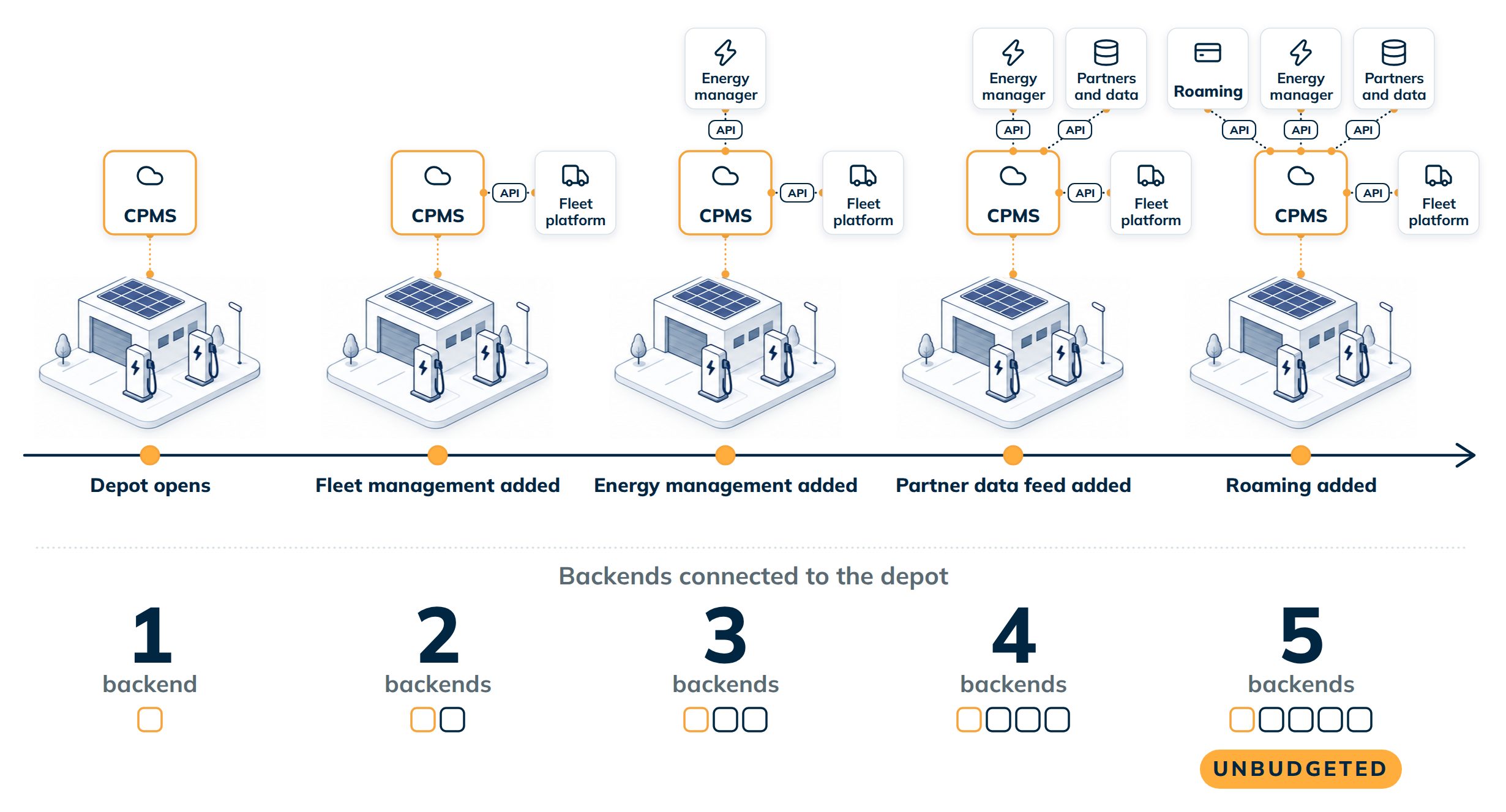
A charger connects to one CPMS. Every other system the fleet runs, such as the fleet platform, energy management, data reporting and partners, has to be integrated with that CPMS’s API, never with the charger itself.
That makes the CPMS the bottleneck. It effectively owns the connection to your chargers, and every other system depends on what its API exposes.
The cost stays hidden until something changes. Switch CPMS, or add a second one, and chargers have to be reconfigured in the field and every integration hanging off the CPMS has to be rebuilt. We call that the integration tax.
Where the tax shows up
Four places where depending on one CPMS costs a fleet time and money.
- +Switching is slow. Moving to a new CPMS means touching chargers in the field and rebuilding every integration that hung off the old one, so the fleet stays with a backend it has outgrown.
- +Every new system waits on the CPMS. Fleet, energy, partner and roaming platforms can only use what the CPMS’s API exposes, so each one is another integration project against that API.
- +Daily operations fragment. Each backend has its own login and its own view of the network, so a simple question like “which chargers are offline right now?” becomes a tour of several systems. The new ChargeBroker portal, coming in December, adds a single operational view across all connected backends.
- +Choices narrow. When changing backends means field work and rebuilt integrations, “we’ll stay with what we have” quietly wins. Freedom of choice becomes a cost, not a right.
Why “just standardize” rarely works
The obvious answer is to pick one charger vendor and one backend. Fleets seldom get to. Site owners decide hardware, incentive programs favor certain suppliers, and acquisitions arrive with their own stack. The mix is a fact to plan around, not a mistake to fix.
Pay the tax once
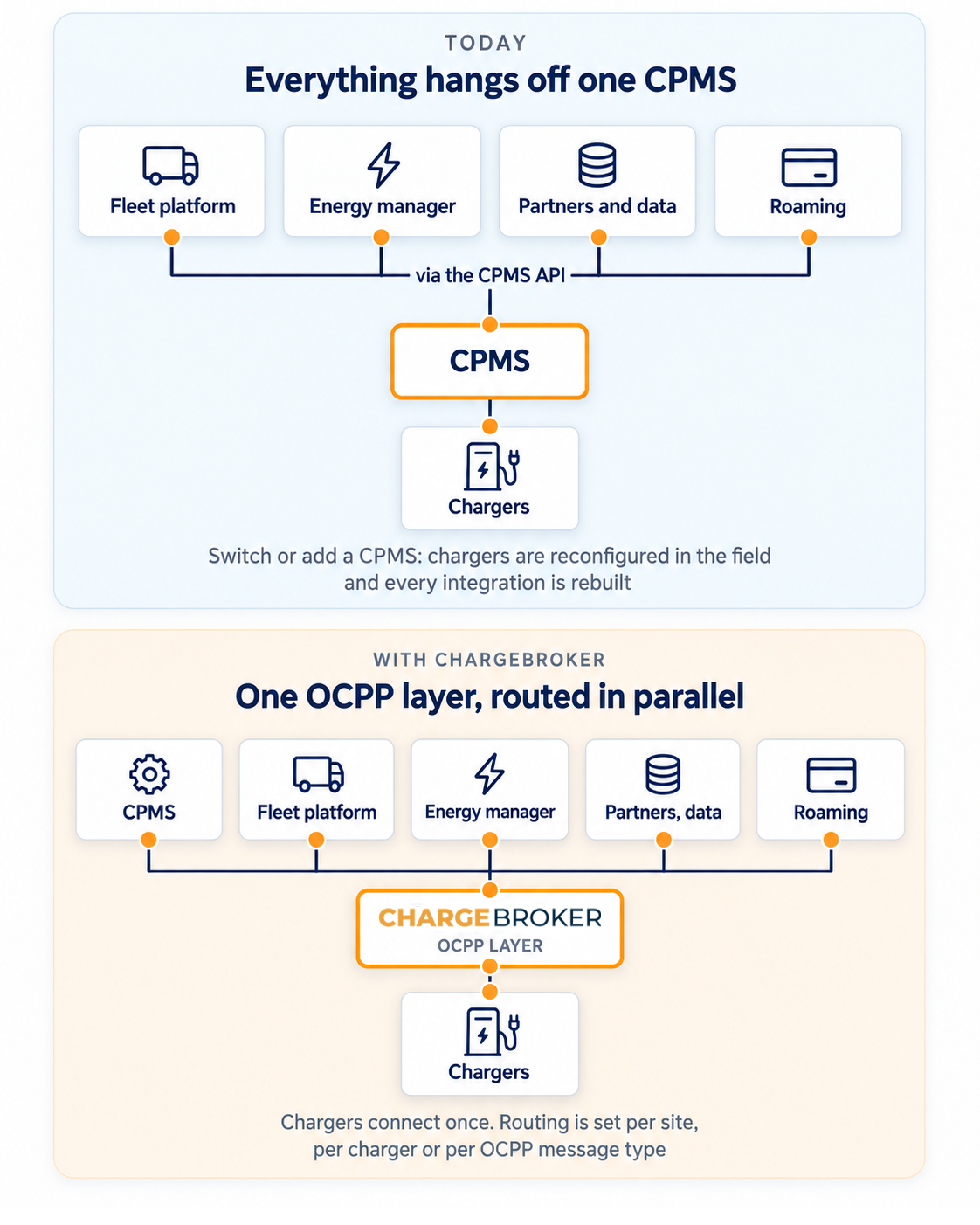
ChargeBroker is a permanent, vendor-neutral OCPP layer. It sits between your chargers and your backends, so the CPMS, fleet platform, energy manager and partners all sit alongside each other and receive the same charger data in parallel.
Through ChargeBroker, the same charger reports to the CPMS, the fleet platform and the energy manager at the same time, with routing set per site, per charger or per OCPP message type. Your CPMS stays exactly where it is: ChargeBroker adds to it and never takes its place.
Chargers connect once, to ChargeBroker. Plug-ins handle the quirks of each charger brand and model once, including real-time protocol transformations and corrections, so no backend has to deal with them. Adding a backend or changing CPMS then happens at the routing level, without reconfiguring chargers in the field.
Fleets keep their freedom to choose hardware and backends, and the CPMS stops being the bottleneck.
The question to ask
If your team has said “that’s another integration project” in the last year, you are already paying the tax. The question is whether every system should keep depending on one CPMS, or sit alongside it.
JIBE Mobility is ISO 27001 certified. Patrick Rademakers, co-author of the OCPP protocol, represents JIBE at the Open Charge Alliance. ChargeBroker runs OCPP 1.6 in production, with OCPP 2.0.1 rolling out and Security Profile 2 supported.