
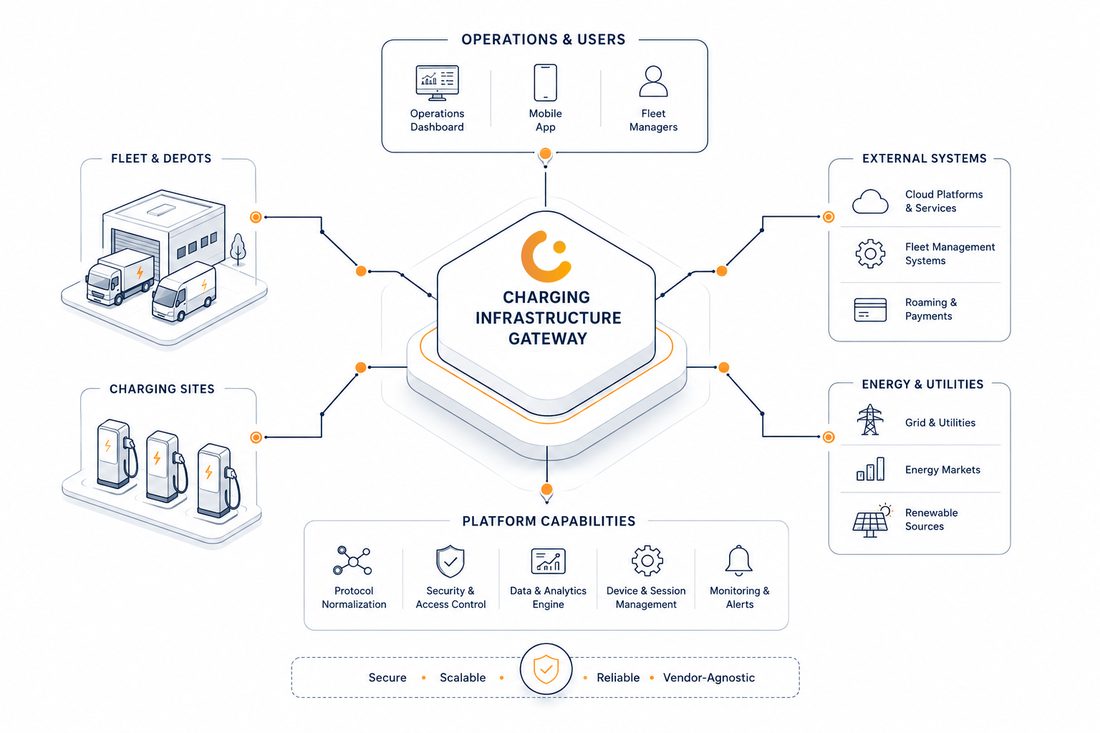
From proxy to orchestration layer
ChargeBroker's core job, sitting between charge points and back-office systems, got a lot more capable this half. The theme: give operators the controls to stop problems before they reach hardware, instead of cleaning them up after.
Reservations API
Reservations used to lock you to one specific charger. Show up and find someone else parked there, and you were stuck. Now a reservation holds a spot in the pool, not a single unit: connect to any available charger, and no charger sits reserved and empty while others queue up. Multi-socket chargers and pool availability are handled automatically, with rescan for failed reservations and full lifecycle status tracking.
OCPP Deep Filtering
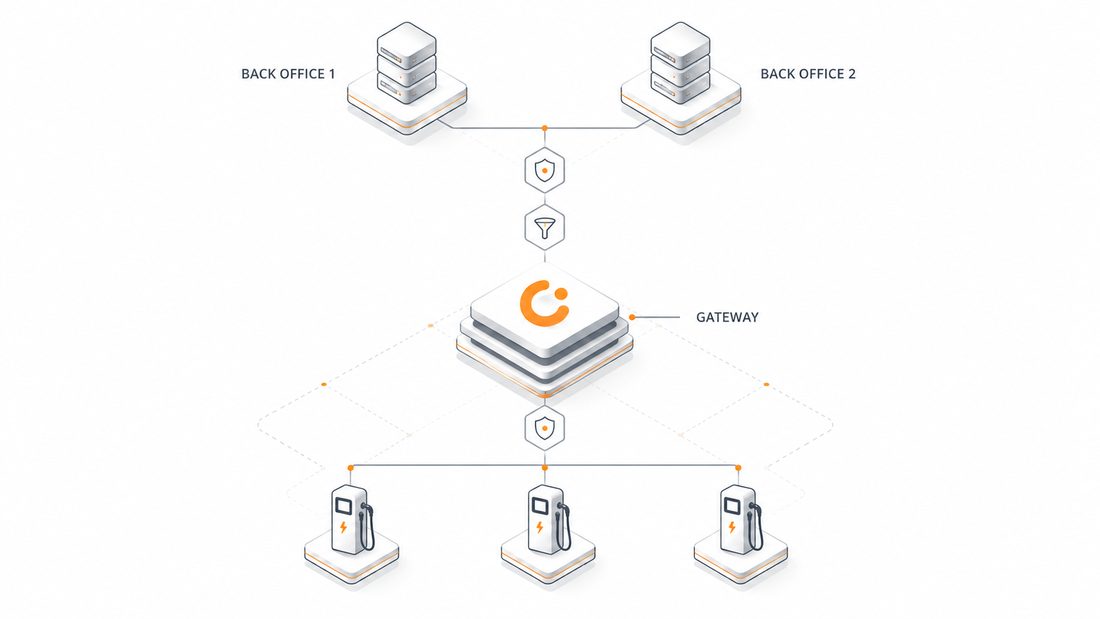
A single misconfigured back office could push a command that broke a charger, with no way to stop it per customer or site. Now operators set the guardrails once: per-server payload filters can be defined for any OCPP operation, with case-insensitive wildcard field matching. Applied to ChangeConfiguration, this means choosing exactly which configuration values each connected back office is allowed to set, so every system only has as much control as it should.
Advanced Routing Logic
Not every charging session can be validated with just your own system. Advanced Routing Logic uses And, Or, and Sequence conditions to authorize a session across multiple back offices at once, enabling both internal and external roaming. If a token isn't recognized locally, a partner system with a broader user base can validate it instead. The same logic works in reverse: expose a charger to another operator, and both your own users and that operator's external validation and billing system can use it, with usage settled back to you as a revenue share.
MeterValues Rate Limiting
Some downstream systems need MeterValues constantly. An EMS integration, for example, might need a reading every few seconds, while everything else on the same charger is fine checking in every five to ten minutes. Sending the high-frequency stream to every consumer would mean unnecessary storage costs and a performance hit for systems that never asked for that much data. MeterValues Rate Limiting solves this per server: it's sliding-window, keyed on the payload timestamp rather than the wall clock, so behavior stays correct during replay or out-of-order delivery. The Leader server returns a valid OCPP response to prevent charger retry loops, while the Follower silently drops the excess.
Security Hardened
Not every charger in the field supports client-certificate authentication, which used to force a trade-off between security and compatibility. ChargeBroker now supports Basic Authentication for those devices, alongside an Enhanced Authentication (Auth 2.x) framework for modern stacks, so operators no longer have to choose one over the other. TLS 1.0 and 1.1 have been dropped entirely; only TLS 1.2 and above are accepted. Combined with per-charger rate limiting, the OCPP layer is secured end to end.
A sharper interface for day-to-day operations
If ChargeBroker is the plumbing, CharliEV is the cockpit: the application your ops team actually opens every day to onboard a charger, check a session, or pull a billing export. This half's focus was closing the protocol gap and making that daily work faster, whether that's finding a location, checking a session, or managing a customer.
OCPP 2.0.1 Support
Mixed 1.6/2.0.1 fleets used to mean either two separate tools or delaying firmware upgrades just to avoid fragmenting operations. CharliEV now supports OCPP 2.0.1 alongside the existing OCPP 1.6 protocol, with functional parity for core charging operations across Provisioning, Authorization, Transactions, Monitoring, Availability, Diagnostics, Firmware, and Security: one interface regardless of protocol version. The EVSE/Connector topology stays stable and consistent across protocol switches, too, so there are no duplicate or stale rows when a charger moves between OCPP versions after a firmware update.
Operational Dashboards & Exports
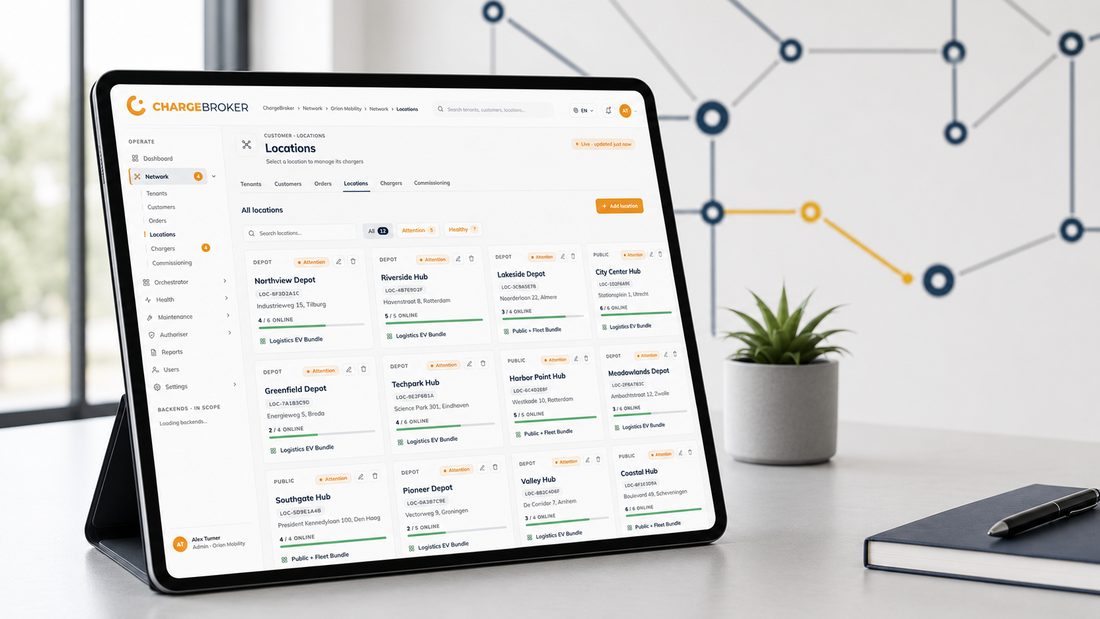
Getting a straight answer on "how healthy is our network right now" used to mean piecing it together across screens. A refreshed charger map and a new EV Charger Status Overview dashboard now give at-a-glance visibility into the operational state of all chargers, and a dedicated Token Overview dashboard shows all tokens, including RFID cards and app tokens, across the organisation. Charge Detail Records can now be downloaded directly for billing reconciliation, and token lists exported for bulk auditing, instead of requesting a one-off export.
SSO Integration
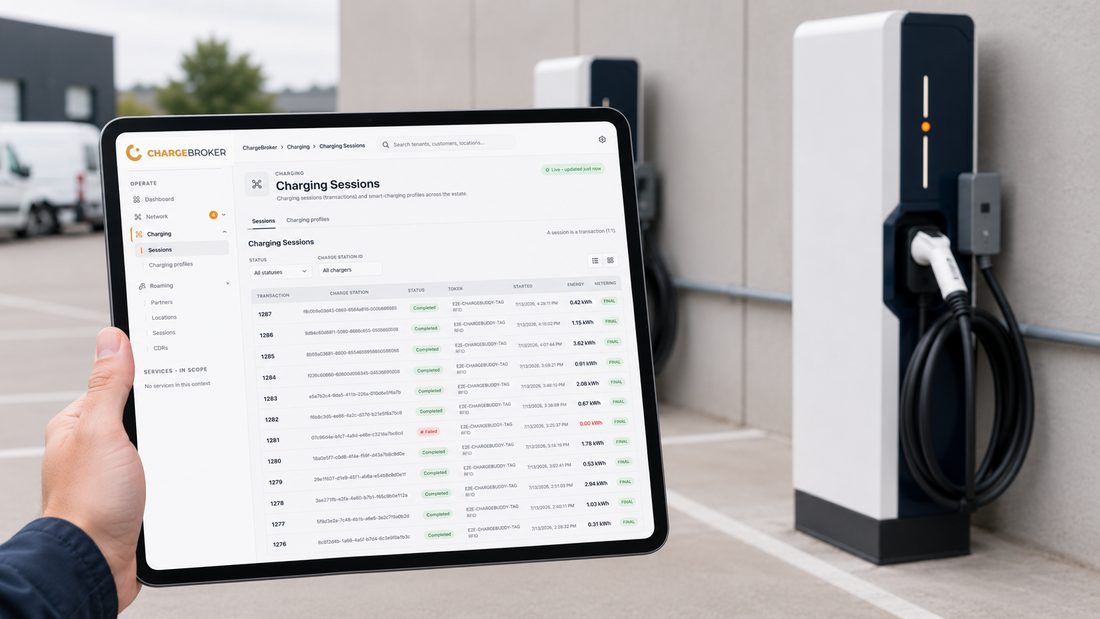
No more spreadsheet of shared logins to manage and rotate. CharliEV now supports Single Sign-On with Google and Azure, so users log in with their organisation's own identity provider: a seamless, secure authentication experience for enterprise teams, and one less credential for IT to babysit.
Customer Hub Redesign
Finding one customer among hundreds used to mean scrolling and squinting. The Customer Hub has been redesigned with pill-based navigation, an improved data grid, type filtering, and column sorting, making it faster to find and manage customers at scale.
Custom OCPP Backends API
A new Custom OCPP Backends API lets external systems retrieve and edit the list of OCPP backends programmatically, so that lookup doesn't have to happen by hand either.
Alert Categories
Alerts used to land in one inbox with no way to tell at a glance what needed attention first. Now each alert can be assigned a category, included right in the email subject line, so downstream systems can route and process alerts automatically instead of a person triaging every one.
Under the Hood
Not every improvement is visible, but operators feel the difference.
- +Multi-threaded OCPP message processing for CharliEV
- +Significantly reduced database storage requirements for ChargeBroker
- +Cursor-based pagination for faster list views
- +Message processing retry mechanism for transient failures
- +Heavy-load stress testing to validate platform stability at scale
What's Next
The second half of 2026 will continue the trajectory from infrastructure to intelligence: deeper protocol control, broader API coverage, and tighter integration between ChargeBroker and CharliEV. We'll share more details in the coming months.